What is Card for card ranking?
Card for Card ranking scores UFC fighters by what collectors pay for their cards, compared like for like. See how it works and the top 50 for 5 October 2026.
The Card for Card ranking orders UFC fighters by how much collectors pay for their cards, after adjusting for which cards were sold. For the week beginning 5 October 2026, the ranking puts Conor McGregor first at 26.0, Jon Jones second at 23.8 and Ilia Topuria third at 21.1, out of 770 ranked fighters. A score of 10 means a fighter's autographs sell for about ten times what the median established fighter's autographs sell for.
The ranking updates every Monday. This post explains how we built it, what the number means and who is in the top 50 for that week. The list below is a frozen snapshot. The live version is on the home page.
What does the Card for Card ranking measure?
We measure a fighter's popularity as the card market prices it. Each fighter gets a score on a scale where 1.0 is the median established fighter, meaning one with at least 30 veteran-autograph sales. There were 467 of those fighters in the week of 5 October 2026. We reset the scale every Monday, so ranks compare across weeks and raw scores do not.
The name comes from pound-for-pound. The UFC introduced rankings in February 2013, voted by a media panel, with a pound-for-pound list that put fighters from different weight classes on one ladder. In June 2026 the UFC began replacing that panel with the Elo-based Meta UFC Rankings, which launched without a pound-for-pound list. We wanted the same single ladder for cards, built from sales instead of votes.
The score applies fully to autographs and only partly to cheaper cards. In the model, a veteran base card carries a popularity weight of 0.16. McGregor's 26.0 therefore lifts his base cards about 1.7 times above the median fighter's equivalent card, from popularity alone, not 26 times.
Why can't you compare card prices between fighters directly?
A price mixes the fighter with the card. On 22 October 2026 Octagon estimates McGregor's 2013 Topps UFC Bloodlines base #139 at $705.59 and Jones's 2009 Topps UFC Round 2 base #101 at $201.07, using data through 20 October. Those two cards come from different releases and different years, so the gap says little about which fighter collectors want more.
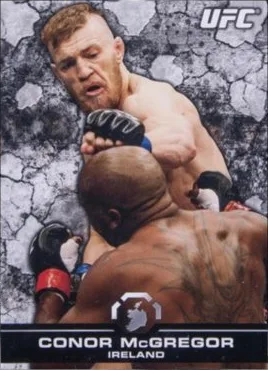
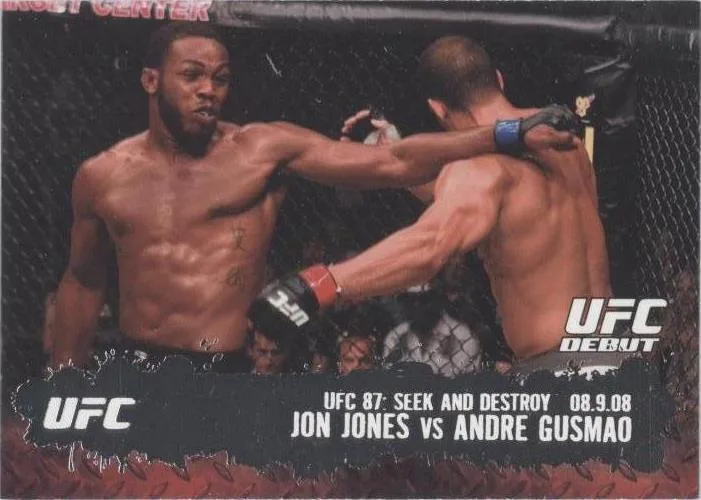
A simple price ratio between fighters fails for two reasons. First, cheap cards sell near the floor. In the sales behind the ranking, 52% of base-card sales and 35% of unnumbered-parallel sales went for $2 or less, so a ratio on those cards measures distance from the cost of shipping, not demand.
Second, rookie cards price on a different scale. These 2023 sales of raw cards show how far a rookie-year market sits from a veteran's.
| 2023 card | McGregor, veteran | Bo Nickal, rookie |
|---|---|---|
| Prizm Blue /175 | $21, 21 sales | $139, 21 sales |
| Prizm Red /199 | $20, 15 sales | $111, 19 sales |
| Autographs, median | $526, 18 sales | $250, 15 sales |
Nickal's rookie parallels sold for five to seven times McGregor's veteran parallels, while his autographs sold for half as much. Card for Card therefore compares each sale only with sales of the same kind of card.
How does the model compare a card with its closest comparables?
We group sales into cells. A cell is one release, one card family, one parallel, one grade bucket and one rookie flag, so we compare a Prizm Blue /175 raw card only with other Prizm Blue /175 raw cards. For each sale the model fits this:
Here
The weights come from the data, one pair for each of 40 tier groups, such as autographs numbered /10 or rarer, relics, /199 parallels and base cards. Popularity is what a fighter's autographs price. Heat is the extra premium or discount their non-autograph cards carry on top. Autographs price popularity alone, numbered parallels price roughly equal parts of both, with weights of 0.59 and 0.61 on veteran /199 raw cards, and base cards price little of either, with weights of 0.16 and 0.24.
Each fighter's popularity moves as a random walk across 13-week windows, so each window starts from the one before:
Every Monday we fit the latest complete week on every sale we have matched to a card, up to that week's Sunday. The headline window is the trailing 13 weeks, and older sales count through the walk. We publish a week once its Sunday is at least seven days old, which is why the week of 5 October appeared on 19 October. Outlier sales count for less, so one unusual auction cannot move a fighter far. McGregor's $196,420 Platinum 1/1 autograph sale on 16 June 2026 is one sale among more than 1.1 million analysed for the week of 5 October 2026.
The ranking shows popularity only, scaled so the median established fighter is 1.0:
Here
Who gets a rank, and who is placed?
We rank a fighter when all three of these hold:
- The catalogue lists them as a fighter.
- A card of theirs from a release later than their rookie year has sold.
- They have five or more veteran-autograph sales.
Personalities, officials and executives get no rank. Dana White would rank fourth if he were counted.
Some fighters have only rookie cards. With 20 or more rookie-card sales, we place them in the list using a comparison of 557 fighters who have both kinds of card. The placement has a wide interval, about a factor of three either way, so a † in the table below means the position is an estimate.
Only autographs separate popularity from heat, because parallels carry both in similar proportions. We therefore value a fighter new to veteran autographs by those autographs alone for the first 13 weeks. From 13 to 26 weeks the value blends toward the model's, and from 26 weeks it is the model's value.
Which fighters rank highest on Card for Card?
This is the top 50 for the week beginning 5 October 2026. The last column is the fighter's rank in the week of 6 October 2025, when 657 fighters were ranked. "Not ranked" means they had no rank that week. A † marks a placed fighter.
The top three held their places from a year earlier within one position. Among fighters ranked a year earlier, the biggest climbers in the top 50 are Roy Nelson from 103 to 40, Don Frye from 75 to 41, Sean Strickland from 55 to 27 and Justin Gaethje from 36 to 9. The biggest falls are Tom Aspinall from 16 to 47, Jean Silva from 24 to 50 and Khamzat Chimaev from 4 to 18. Further down, in the same week, the score is 2.3 at rank 100, 1.5 at rank 200, 1.1 at rank 300 and 0.7 at rank 500.
Five of the top 50 are placed from rookie cards alone.
How do we know the ranking works?
We tested it on prices. We hid 10% of cards along with all their sales, so the model never saw them. It priced a card within 1.5 times its median sale 66% of the time over 5,208 cards, against 43% for the cell median. We also fitted two disjoint random halves of all sales separately. They put the 342 fighters with at least 30 veteran sales in both halves in almost the same order, and 29 of the top 30 fighters appeared in both.
How do I read a fighter's rank?
Read the rank first and the score second. The rank says where a fighter sits on that Monday's list. The score says how far above or below the median established fighter their autographs sell. Do not compare scores from different weeks, because the scale resets, but do compare ranks. The list grew from 657 fighters a year ago to 770 now, so a rank can also fall when new fighters arrive above it.
Each fighter page shows the weekly rank history, and the home page charts the live top 20. To price one of the cards behind the ranking, scan it or browse the checklists for the 2013 Topps UFC Bloodlines release.