By Octagon Cards · Updated
Jon Jones rookie cards and his first autograph
Compare Jon Jones rookie cards, including 2009 Topps UFC Round 2, the debated MMA Review magazine card, his first autograph and dated sales.
Start your search for Jon Jones rookie cards with 2009 Topps UFC Round 2 #101, the landscape card showing Jones fighting Andre Gusmao. His first autograph is a separate card, Round 2 Autographs #FA-JJ. Both belong to the 2009 release, but they have different designs, editions and sale histories.
Topps's Jones collecting guide identifies #101 as his rookie and describes the Round 2 autograph as his first auto. Use the Jones fighter page for the catalogue and first-card milestones; this guide explains what to check when comparing those cards.
Which Jon Jones rookie card is #101?
The unsigned bout card comes from 2009 Topps UFC Round 2. It shows Jones on the left and Gusmao on the right, with their names across the lower panel and a UFC Debut mark beside the action.
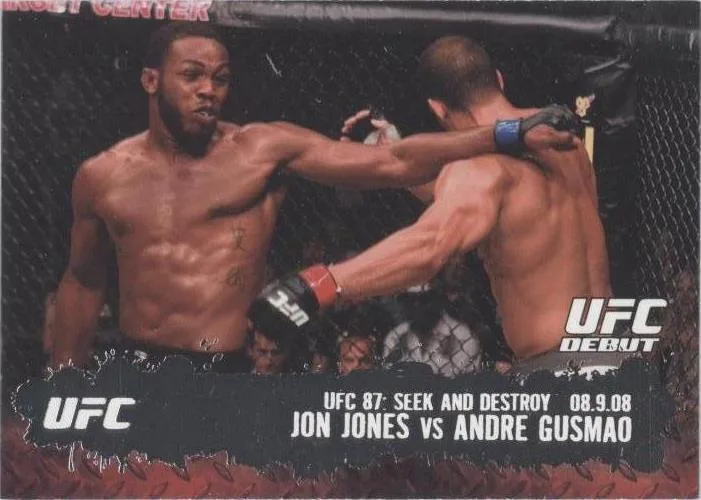
Jones's name alone is not enough to identify this card in a listing. Match Round 2, #101 and the two-fighter image. A later Jones card or an autograph from another set can share the same fighter name without being the rookie-year edition you want.
The front's date is another potential source of confusion. It reads 08.9.08 because the image relates to his debut against Gusmao at UFC 87 on 9 August 2008, as UFC's career history records. That is the event date. The card belongs to the 2009 product.
What about the MMA Review magazine rookie card?
Another candidate is the card listed as 2009 MMA Review Magazine #5 Jon Jones, also sold as a Revgear rookie. It is associated with MMA Review's Northeast Edition magazine. The photographed cover reads "Spring 2009" and advertises nine MMA trading cards inside. Magazine listings describe an uncut sheet containing Jones's card.
The debate concerns both what counts as a rookie and when the cards were made. A magazine insert is a different kind of release from a Topps UFC card. It is also unclear whether separately sold, machine-cut copies belonged to the original release. The magazine's cover date cannot establish the age of a loose card.
Be careful with the "pre-UFC" description attached to some copies. Jones made his UFC debut in August 2008, before the magazine's printed 2009 cover date. An earlier photograph does not establish an earlier card release. We have not verified an original distribution date that proves the magazine card reached collectors before Round 2.
If you want the magazine card, ask for evidence of the original issue and whether the copy came from an uncut sheet or was supplied separately. Keep its sales separate from #101 when comparing prices.
Is the first autograph a different rookie-year card?
#FA-JJ uses a portrait design with an autograph panel. The standard example below has a blue signature beneath the printed words identifying it as a Topps certified autograph issue. It is visually different from the unsigned #101 bout card.
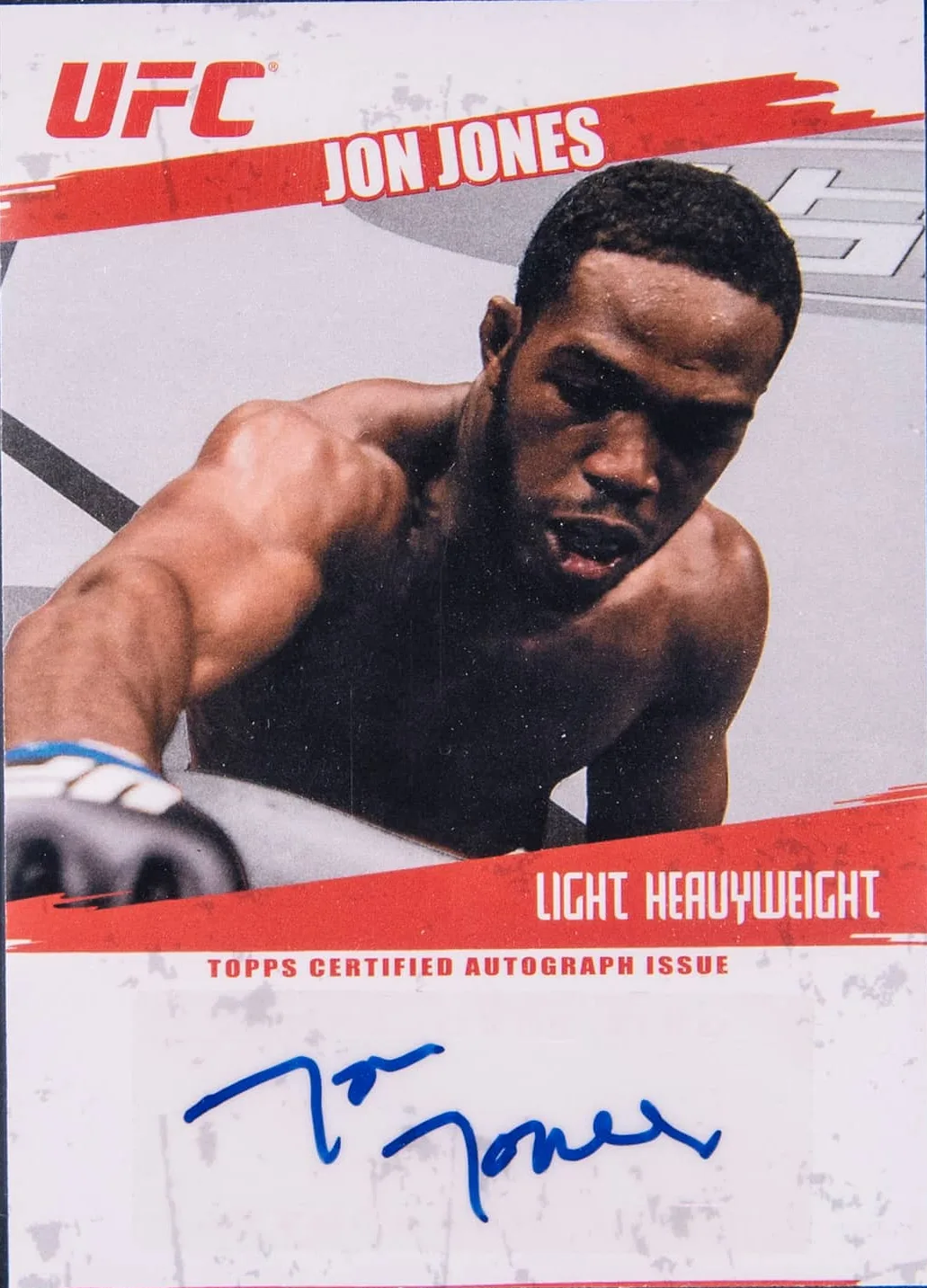
Topps also describes this autograph as a rookie auto. Calling it Jones's first autograph or rookie-year autograph identifies the distinction without treating it as another copy of #101. When comparing prices, keep #FA-JJ sales separate from the unsigned card.
Check the actual card number against the Round 2 autograph checklist. A seller's short title may omit the parallel or use rookie as a broad description. The release, printed identifier and signature colour give you a more specific match.
How do base, Gold and Red Ink differ?
The Gold #101 parallel shares the base card's fight photo. Its lower nameplate is gold-toned. Both editions are unnumbered in Octagon's catalogue as checked on 23 October 2026.

The Red Ink #FA-JJ belongs to the autograph family. Octagon lists that edition as /25. That catalogue print run does not establish the serial number of any particular photographed copy.
| Edition | Card number | Identifying detail | Catalogue numbering, checked 23 October 2026 |
|---|---|---|---|
| Base bout card | #101 | Landscape fight image, dark nameplate | Unnumbered |
| Gold bout card | #101 | Same fight image, gold-toned nameplate | Unnumbered |
| Standard autograph | #FA-JJ | Portrait with blue-ink signature | Unnumbered |
| Red Ink autograph | #FA-JJ | Portrait with red-ink signature | /25 |
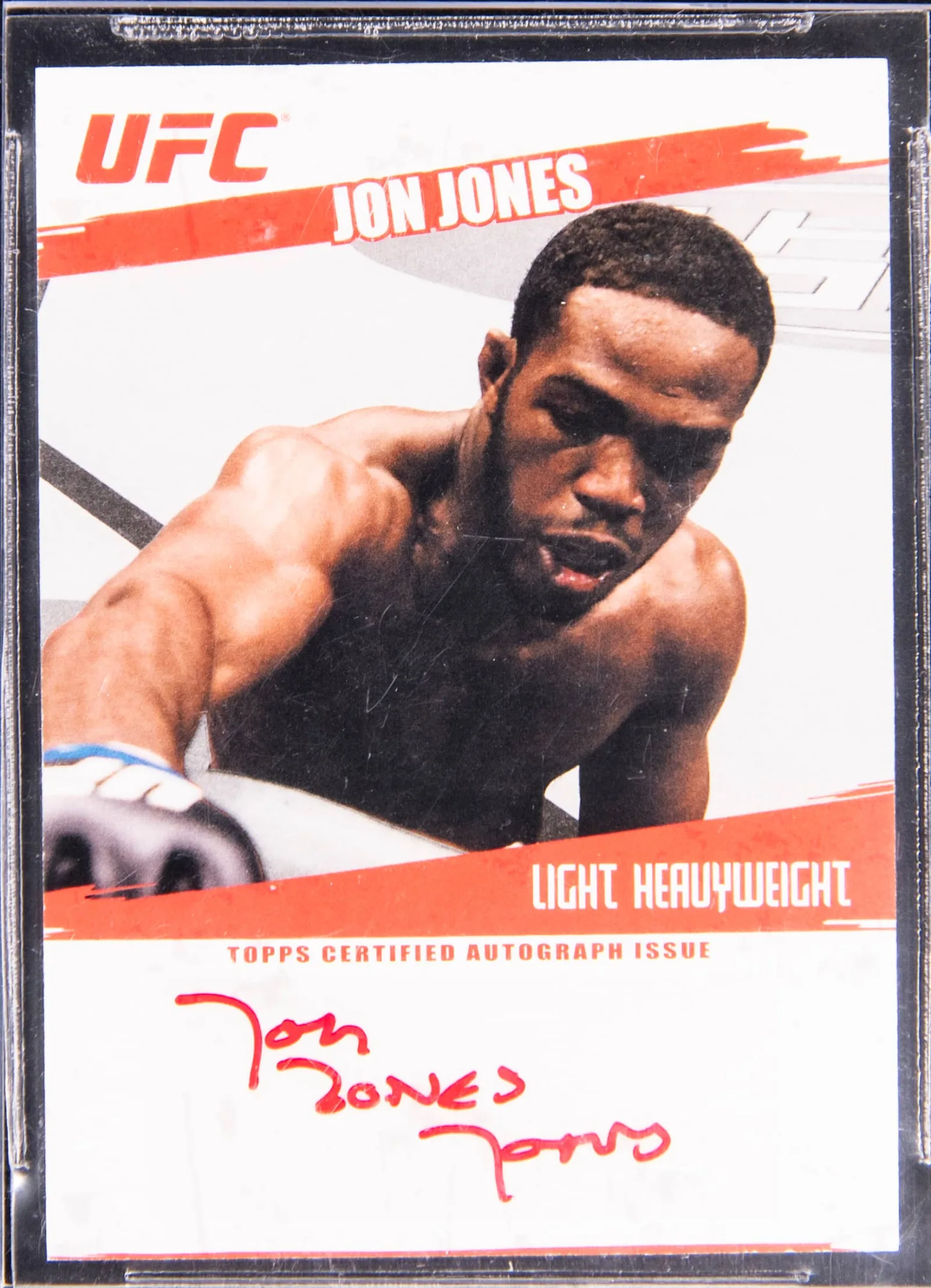
The Red Ink example shows extra handwriting beneath the signature and the edge of a holder. Its grade label and serial are not visible. It illustrates the edition, not the specific copy in the sale below.
What have these Jon Jones cards sold for?
These are selected Octagon sale records retrieved on 23 October 2026. They illustrate the different editions and conditions, rather than the newest sale for every card or a complete price range. They do not promise what another copy will fetch. All amounts are USD; sale dates use UTC, matching the card pages.
| Card | Recorded condition | Sale date | Price |
|---|---|---|---|
| #101 base | Raw | 27 September 2026 | $200 |
| #101 Gold | Raw | 26 September 2026 | $475 |
| #FA-JJ standard autograph | Raw | 7 October 2026 | $2,499.99 |
| #FA-JJ Red Ink /25 | Grade 9.5, grader not recorded | 16 June 2026 | $52,460 |
The Red Ink result does not price the ordinary bout card. It combines a different card type, parallel and recorded grade. Likewise, the $200 base sale is an example, not its latest sale or a guaranteed floor. The same snapshot includes a raw $7.01 base sale dated 14 October 2026 that needs further context before treating it as representative.
Octagon's grade-independent estimates dated 22 October 2026, using sales through 20 October, were $201.07 for #101 base and $1,729.47 for the standard #FA-JJ autograph. An estimate describes the edition; a dated sale describes a transaction involving a particular copy. Compare the physical condition and exact edition before applying either to a purchase.
The valuation guide explains that comparison. For the complete list of Jones cards and links to their current evidence, open the Jon Jones catalogue.