By Octagon Cards · Updated
How to value UFC cards
Learn how to value UFC cards by matching editions, checking sold prices and accounting for fighter demand and a market with few buyers.
Working out what a UFC card is worth can be frustrating. A fighter may have just lost a big fight or made headlines for the wrong reasons. That can leave you unsure whether an older sale is still a useful comparison.
There are base cards, coloured parallels, autographs and memorabilia cards, often with several versions of the same design. Some sell infrequently. You might find a price from months ago, an ambitious asking price and very little else. Even a rare card can be illiquid, meaning it takes time to find someone willing to buy it at the price you want.
Use the available sales to work out a price you can explain. Start with the exact card, check what buyers have paid, then consider what has changed since those sales.
This guide leaves grading and graded-card premiums aside. All sale examples below are for ungraded cards. Physical condition still matters when comparing copies.
Start with the exact card
A fighter's name is only the beginning. Find the product year, set, card number and parallel, along with any autograph or memorabilia. A parallel is another version of a card, often distinguished by its colour, finish or serial numbering. If you're unsure which version you have, use the photo identification guide or the UFC card scanner.
For example, Jon Jones and Andre Gusmao appear together on 2009 Topps UFC Round 2 #101. The Gold parallel uses the same fight photo, but has a gold-toned nameplate. They are separate editions with separate sale histories.
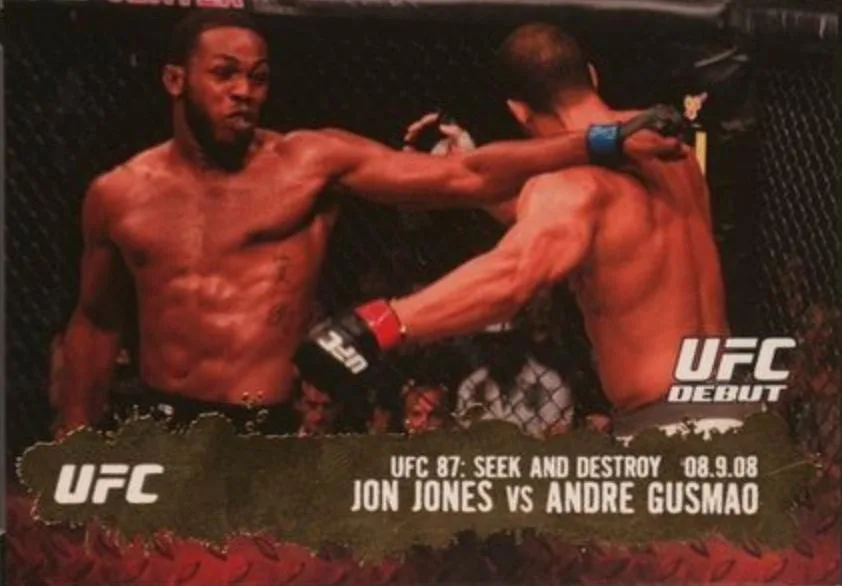
Check the Round 2 checklist before assuming what Gold means. Octagon lists both these editions as unnumbered as of 23 October 2026. A colour name alone does not tell you the print run.
The same care applies to rookie cards. Jones's first autograph is a different card from this unsigned bout card. The Jon Jones rookie-card guide shows the difference, so you can avoid using an autograph sale to price the base card.
How to value UFC cards with recent sales
Look for completed sales of the edition you own. Asking prices show what sellers hope to receive; completed sales show what a buyer paid on a particular occasion.
Here are two examples of recorded sales on Octagon, retrieved on 23 October 2026. Each identifies the edition, date and price. Prices are USD and sale dates use UTC, matching the card pages.
| Card | Recorded sale date | Sale price |
|---|---|---|
| Jones / Gusmao, Round 2 #101 base | 27 September 2026 | $200 |
| Jones / Gusmao, Round 2 #101 Gold | 26 September 2026 | $475 |
These selected sales do not establish a typical price or a fixed premium for Gold. The $200 base sale is not its latest. Compare several sales where possible, and inspect the photos and descriptions for differences such as creases or damaged corners.
Be wary of treating the newest number as the answer. The same Octagon snapshot includes a $7.01 sale of the base card on 14 October 2026. That is much lower than the September example, but the two records alone do not explain why. Check the underlying card details before treating either price as typical.
Has demand for the fighter changed?
Check whether the sale happened before or after a major fight. A price agreed beforehand may be less useful after it. The same question applies when a fighter becomes the subject of controversy outside the cage. Has it changed what collectors are actually buying, or only what people are talking about?
Topps identifies athlete performance and collector demand as factors in card prices. There is no fixed adjustment you can apply after a loss, and headlines alone do not tell you how much a card's value has changed. Look for sales after the event before deciding that an older price is still representative.
Octagon's Card for Card ranking gives broader context on demand for fighters. You still need sales of the particular card to judge its price.
What if there are hardly any sales?
With an infrequently traded card, you may have to work with older sales or related editions. Start with older sales of the exact card, then check nearby parallels if you need more context. Keep the differences visible in your notes.
For the Jones example, a base-card sale may help you understand interest in the design, but it is not a sale of the Gold edition. Nor does a smaller print run tell you exactly how much more to charge. Scarcity describes the supply; you still need a buyer who wants that particular card.
A gap in sales also says something about how certain you can be. It does not prove the card is worthless or that nobody wants it. It means there is less recent evidence to support a precise price. Be prepared to revise your estimate when a useful new sale appears.
Where does an Octagon estimate fit?
An estimate gives you another reference when the sales history is hard to interpret. Octagon's estimate for the Jones / Gusmao Round 2 #101 base card was $201.07 as of 22 October 2026, using sales through 20 October. It is an estimate for the edition, not an appraisal of the physical copy in your hand or an offer to buy it.
Open the card page and read the estimate alongside its date and the supporting sales. Check whether each comparison is the same card or a related edition. A displayed estimate is not simply the average of whichever sales are visible on the page.
If Octagon shows no estimate, leave it out of the comparison. The page may still have recorded sales you can inspect. A missing estimate is not a value of zero.
What price should you actually ask?
Decide how much time you have to sell. An asking price you are willing to wait for is different from a price a buyer is offering today. If you need a quick sale, you may have to accept less. If you can wait, you can test a price supported by the comparisons, but a listing is not proof that the card will sell for that amount.
Keep a short record of the exact edition, relevant sale dates and the reasons your copy might sell differently. When several comparable sales support a similar price, you have a stronger basis for your asking price. When the evidence is thin or contradictory, leave room for negotiation instead of presenting a precise figure as certain.
Value your cards with the Octagon app
The best way to put this guide into practice is with the Octagon app. Search for your fighter, open their page and browse their cards. Select your exact card and parallel to see its recorded sales and any available estimate. You can start with Jon Jones's fighter page.
If you have the card in front of you, use Octagon's card scanner to find a match from a photo. Confirm the edition, then open its card page to check the sales and estimate.